
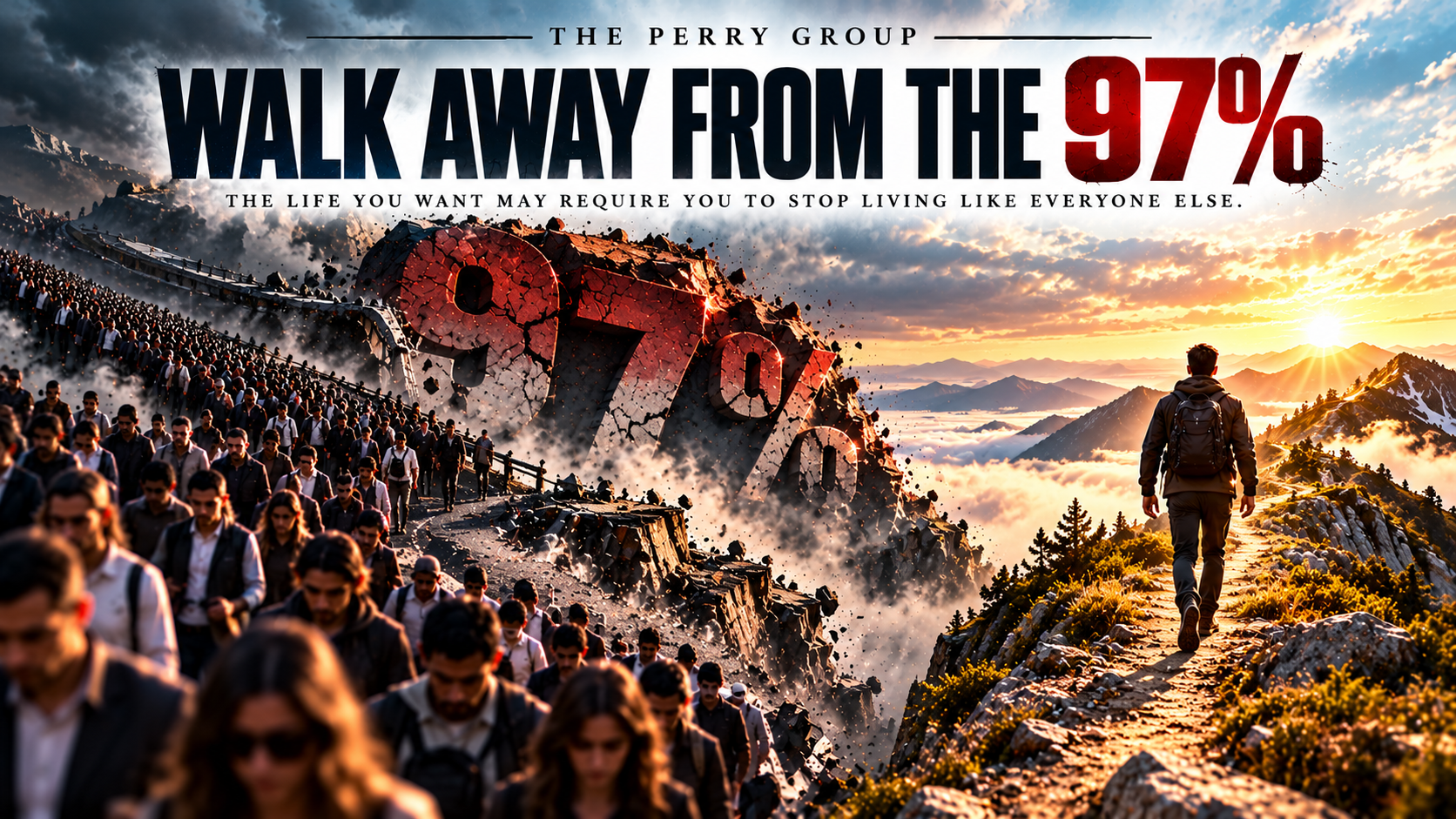
THE PERRY GROUP PRESENTS
WALK AWAY FROM THE 97%
The life you want may require you to stop living like everyone else.

In March of 2020, the world changed almost overnight.
Businesses were closing. People were being laid off. Fear and uncertainty were everywhere.
At the beginning of March, my organization had roughly 180 people. About 90 days later, we had nearly 320.
That was almost 80% growth during a period when many companies were packing up, laying people off, or trying to figure out how they were going to survive.
It wasn’t because the circumstances were easier for us.
I got COVID twice. My son, who wasn’t even three years old at the time, got COVID too. Family members got sick. People in our organization left for other opportunities. My own income faced uncertainty.
The circumstances were real.
The difference was how I chose to respond to them.
Instead of only asking what was going wrong, I started asking different questions:
How can we still contribute?
How can we still deliver value to people?
How can we continue serving people regardless of the circumstances we’re dealing with?
I learned something during that season that I have carried with me ever since:
WHAT’S WRONG IS ALWAYS AVAILABLE. SO IS WHAT’S RIGHT.
Years earlier, I had heard Tony Robbins teach a principle that changed the way I looked at difficult circumstances: life doesn’t just happen to us; it can happen for us.
That doesn’t mean everything that happens is good.
It means that when something happens, another question becomes available:
What opportunity is being presented to me because of what is happening?
That question changes what you begin looking for.
And that brings me to something Jim Rohn taught that has stayed with me for years:
Walk away from the 97%.
Not because you are better than anybody.
Because sometimes the life you want requires you to stop living according to what everybody around you has accepted as normal.
THE 97%, THE 1%, AND THE 2%
I use 97%, 1%, and 2% as a framework — not as researched population statistics.
THE 97%
The 97% usually mean well.
They have dreams. They talk about what they want. They know there are things they should change.
But too often, intention never becomes consistent action.
“I’m going to start.”
“I need to get healthier.”
“I’m going to apply.”
“I’m going to stop doing that.”
“I’m going to build something.”
Then another week passes.
Good intentions don’t change your direction.
Decisions do.
THE 1%
The 1% is not a permanent group of people.
It is a mindset — especially complacency.
You can find it on a street corner or inside a boardroom.
It is the place where someone knows they want more but has stopped participating in creating it.
Maybe they work all week, come home, complain about what they don’t have, and never spend meaningful time building what they say they want.
Maybe they have accepted destructive habits.
Maybe they have simply decided:
“This is just my life.”
But nobody has to stay there.
The moment you become honest about where you are, you can begin walking somewhere different.
THE 2%
The 2% are not necessarily richer, smarter, more talented, or more connected.
They are willing to participate.
They work on themselves.
They seek information.
They accept accountability.
They practice discipline.
They take action.
They solve problems.
They contribute.
And when they fall, they get back up.
Being part of the 2% isn’t a title.
It is evidence.
NORMAL IS NOT ALWAYS THE DESTINATION
Where I grew up, certain things could become normal.
Shortcuts could become normal.
Hustling could become normal.
Blaming circumstances could become normal.
But there is another version of normal too.
Go to work.
Come home.
Complain about the boss.
Complain about the pay.
Wish you had more time with your children.
Wish things were different.
Then wake up and repeat it.
I remember working a job and listening to older coworkers talk about those things.
My son was young at the time.
And I remember thinking:
If I continue doing the same things, following the same habits, and walking the same path, why would I expect a different outcome?
I wanted financial freedom.
I wanted time freedom.
I wanted to be present with my son.
And I wanted to create opportunities instead of always asking somebody else for one.
That realization started changing what I considered normal.
A book led to a workshop.
A workshop led to personal-development events.
Those events put me in different rooms.
Different rooms introduced me to different people.
And different people exposed me to different possibilities.
I didn’t need to fire all my old friends.
I expanded my circle.
Some relationships grew with me.
Some changed.
Some naturally faded.
PROXIMITY IS A BIG DEAL.
CHANGE THE SOIL
I started paying attention to what I was putting into myself.
I listened repeatedly to people like Jim Rohn and Les Brown.
Sometimes friends would ask:
“Didn’t you already hear that?”
Yes.
That was the point.
They were bored by repetition.
I was being reinforced by it.
I changed what I read.
I changed what I watched.
I changed some of the conversations I participated in.
I became more intentional about my disciplines, my mornings, my time, my self-talk, and what I repeatedly allowed into my mind.
Eventually, the fruit that came out of me was different because my soil was different.
Your environment matters.
Especially when you are young.
When we’re children, our environment has tremendous influence over us.
Most of us reading this will claim not to be children anymore.
At some point, we have to decide what continues getting access to us.
My environment and my past can speak to me, but they don’t have the power to control me.
CREATE A FUTURE STRONG ENOUGH TO PULL YOU
If someone had sat me down when I was 15 and asked:
What do you really want your life to look like in five, 10, or 15 years?
I don’t know what I would have said.
At 15, I was dealing with juvenile hall, probation, anger-management classes, REACH classes, and regular court visits.
I was consumed with what was directly in front of me.
And my actions became congruent with what had my attention.
Imagine instead asking a young person — or yourself:
What kind of man or woman do you want to become?
What kind of family do you want?
Where do you want to live?
What kind of work do you want to do?
What problems do you want to solve?
What do you want your children to experience?
Who do you want to serve?
What if what you see around you right now isn’t the ceiling?
WHEN YOUR FUTURE BECOMES MAGNETIC ENOUGH, YOUR PAST BEGINS LOSING ITS POWER TO PULL YOU BACKWARD.
THE FIVE MOVEMENTS
Walking away requires more than motivation.
It requires movement.
Here are the five movements I use:
SEE IT
You need something worth walking toward.
Get alone.
Ask better questions.
Write your answers.
Picture your health, family, faith, finances, career, relationships, contribution, and legacy.
Don’t only ask what you want.
Ask why you must become the person capable of creating it.
A vision you visit once is easy to forget.
A vision you repeatedly visit begins influencing the way you live.
CHECK YOUR FRUIT
Stop judging your life only by your intentions.
Look at the evidence.
What have you actually completed?
Where are you growing?
Where are you talking more than acting?
Where have you become complacent?
You can be disciplined in one area and complacent in another.
Find the gap.
TAKE THE NEXT STEP
You do not need the entire staircase.
You need the next step.
What do you already have?
What do you actually need?
Who has the kind of fruit you can learn from?
What meaningful action can you take in the next 24 hours?
Send the email.
Make the call.
Apply.
Register.
Study.
Train.
Start.
POSSIBILITY REQUIRES PARTICIPATION.
TAKE THE EIGHT-COUNT
You are going to miss.
You are going to have bad days.
You may make a decision on Monday and mess up by Friday.
That doesn’t erase the decision.
When a boxer gets knocked down, sometimes the smartest thing isn’t jumping up without understanding what happened.
Take the eight-count.
What hit me?
What was underneath it?
What decision led here?
What do I need to change?
Then get back up.
Never miss twice without examining why.
RAISE THE BAR
Eventually you begin creating evidence.
I said I would get up — and I got up.
I said I would exercise — and I exercised.
I said I would write — and I wrote.
I fell — and I got back up.
That evidence begins changing the question.
Instead of:
“Can I do this?”
You begin asking:
“What else am I capable of?”
That is where you raise the bar.
REGRET OR SATISFACTION
For years, I sold life insurance and spent time in senior communities and assisted-living facilities.
I had conversations with people in their 80s and 90s.
Some conversations have never left me.
There is a certain weight in hearing someone talk about the person they never married, the business they never started, the job they never took, the apology they never made, or the opportunity they were too afraid to pursue.
Then you meet somebody else who took the risk.
They moved.
They tried.
They loved.
They built.
They failed.
They started again.
The way they talked about their life was different.
That taught me something:
Walking away from the 97% may become one of the biggest decisions you ever make.
Because 10, 15, or 20 years from now, you’re going to look back at the decisions you’re making today.
And when you do, you’ll have something:
REGRET — OR SATISFACTION.
You’ll either wish you had started when you had the opportunity, or you’ll be grateful that you did.
Your past can speak.
Your environment can speak.
Your circumstances can speak.
Your feelings can speak.
BUT THEY DON’T HAVE TO CONTROL YOU.
What’s wrong will always be available.
So will what’s right.
You don't have to change everything today.
You just have to take the next step.
THE DECISION
Start here:
I know in my heart I’m meant for more.
I want the information.
I commit to acting on the information — even after I fall down.
Then remind yourself:
“My life is meant for more than what I see around me, and I am willing to put in the work to experience the life of my dreams.”
TODAY.
TAKE THE NEXT STEP
READ IT.WORK THROUGH IT.LIVE IT.
DON’T JUST READ IT.
WORK THROUGH IT.
Walk Away From the 97% doesn’t end with the article. Go deeper into the framework, then put it into practice.
THE DEEPER WORKING VERSION
WALK AWAY FROM THE 97%
THE FRAMEWORK GUIDE
Go beyond the headline article and work through the five movements in greater depth through expanded teaching, reflection, practical exercises, stories, and application.
DOWNLOAD THE FRAMEWORK GUIDE
PUT THE FRAMEWORK INTO PRACTICE
WALK AWAY FROM THE 97%
THE 10-DAY CHALLENGE
Move from understanding the ideas to intentionally practicing them through daily reflection, action, documentation, and evidence.
DOWNLOAD THE 10-DAY CHALLENGE